Typical Residence Requirements
- ✓ 10 years of legal residence (general rule)
- ✓ 2 years for nationals of Ibero-American countries, Andorra, the Philippines, Equatorial Guinea or Portugal, and Sephardic Jews
- ✓ 1 year for those married to a Spanish citizen or born in Spain
Other Routes to Citizenship
By option
For people who were or should have been under Spanish parental authority, or whose parent was originally Spanish.
Carta de naturaleza
Granted at the government’s discretion, typically for exceptional circumstances (e.g. the Sephardic origin law).
By residence (the most common)
Based on legal, continuous residence for the required years — detailed below.
Exam Requirements
- ✓ CCSE (Spanish constitutional and sociocultural knowledge) — mandatory for all applicants
- ✓ DELE A2 Spanish exam — mandatory for nationals of non-Spanish-speaking countries
- ✓ Both are Instituto Cervantes exams, valid indefinitely once passed
The Steps We Help With
DNI/Civil Registry Appointment
The in-person appointment to file or finalise your citizenship case.
Oath Ceremony
Once approved, the oath of allegiance appointment that completes your citizenship.
Documents Normally Required
Mandatory
- 📄 Passport and residence card (TIE)
- 📄 Birth certificate, apostilled and translated
- 📄 Criminal record certificates (Spain + country of origin)
- 📄 Proof of the legal residence period (padrón/TIE history)
Optional / case by case
- 📄 CCSE / DELE exam certificates
- 📄 Marriage certificate (if applying through a spouse)
- 📄 Renunciation of nationality (where required)
How to apply for Spanish citizenship: the full route
Spanish citizenship by residence is decided by the Ministry of Justice, not by the immigration office, and it is filed as a single electronic file. Almost everything that goes wrong goes wrong before filing: a missing apostille, an expired certificate, or an exam that had not been passed yet.
This is the route in the order it actually happens, with the parts that catch people out.
1. Check which residence period applies to you
- Ten years — the general rule for most nationalities.
- Five years — people granted refugee status.
- Two years — nationals of Ibero-American countries, Andorra, the Philippines, Equatorial Guinea and Portugal, and people of Sephardic origin.
- One year — including: born in Spain; married to a Spanish national for at least a year and living together; widow or widower of a Spaniard; child or grandchild of a Spaniard by origin; and people who were legally under Spanish guardianship or fostering for two years.
The residence must be legal, continuous and immediately before the application. Long absences break continuity, and this is one of the most common reasons for refusal.
2. Pass the exams before you file
- CCSE — a test on the Spanish Constitution and sociocultural knowledge, required for practically all applicants.
- DELE A2 — Spanish language, required unless you are a national of a Spanish-speaking country.
- Both are booked through the Instituto Cervantes and have their own sittings and fees; the certificates are valid for a set period, so booking them too early is also a mistake.
3. Prepare the documents
- Birth certificate from your country, apostilled or legalised, with a sworn translation into Spanish.
- Criminal record certificate from your country of origin, and one from Spain.
- Passport and current residence card (TIE) or EU certificate.
- Registration certificate (empadronamiento) proving where you live.
- CCSE and, where applicable, DELE A2 certificates.
- Marriage certificate, family book or the Spanish relative’s documents when applying through those routes.
- Proof of the application fee.
Documents that were issued a long time ago are frequently rejected: birth and criminal record certificates are normally expected to be recent, and the apostille has to be on the document you actually submit.
4. File the application
The file is submitted electronically to the Ministry of Justice. In practice you need a digital certificate or Cl@ve, or a lawyer or authorised representative who files with theirs. Once filed you receive a file number, and from then on the status can be checked online without going anywhere.
5. Wait, and track the file
The legal deadline is one year from the complete file. Longer waits are common, and the Ministry may ask for extra documents — those requests have short deadlines, so the file has to be watched. Silence is not a refusal.
6. Swear allegiance and register
- With a favourable decision you have a limited window to appear at the Civil Registry to swear or promise allegiance to the King and obedience to the Constitution and the laws.
- Your birth is then registered in Spain, which produces the Spanish birth certificate.
- Only after that can you apply for the DNI and the Spanish passport — each with its own appointment.
While your file is pending
Citizenship does not extend your residence card. If the TIE expires while the file is being decided, the renewal still has to be filed on time and the fingerprint appointment still has to be booked. That part — the appointments — is what we handle: the Civil Registry appointment for the oath, and the police appointments for your card in the meantime.
Last reviewed: 1 September 2026.
Sources: the Spanish Civil Code and the current nationality-by-residence regulations, the Ministry of Justice electronic office and the Instituto Cervantes. Check the official information before filing.
General information only; this is not legal advice. Requirements and timeframes can change.
Frequently asked questions
How do I apply for Spanish citizenship?
Applications by residence are filed electronically with the Ministry of Justice, with the supporting documents legalised and translated, the CCSE test passed and — where required — the DELE A2. A digital certificate or Cl@ve is normally needed to file, or a lawyer files on your behalf. The oath of allegiance at the Civil Registry is the final step once the file is approved.
How many years of residence do I need?
Ten years as a rule; five for refugees; two for nationals of Ibero-American countries, Andorra, the Philippines, Equatorial Guinea, Portugal and people of Sephardic origin; and one year in a set of cases including being married to a Spanish national for a year, being born in Spain, or being the child or grandchild of a Spaniard by origin.
Which exams are required?
The CCSE test on constitutional and sociocultural knowledge is required for almost everyone. The DELE A2 Spanish exam is also required unless you are a national of a Spanish-speaking country. Both are booked separately through the Instituto Cervantes.
How long does the decision take?
The legal maximum is one year from the complete file, and in practice it commonly runs longer. The file can be tracked online, and silence does not mean refusal — it means the file is still open.
Does Spanish citizenship require giving up my nationality?
Spain asks applicants to renounce their previous nationality, with an exemption for nationals of Ibero-American countries, Andorra, the Philippines, Equatorial Guinea and Portugal. In practice many countries do not register the Spanish renunciation, but that is a matter for your own country’s law.
What documents are normally required?
Birth certificate, criminal record certificate from your country of origin and from Spain, passport, residence card, registration certificate (empadronamiento), CCSE and DELE certificates where applicable, and proof of the fee. Foreign documents need an apostille or consular legalisation and a sworn translation.
When do I get the Spanish passport?
After the favourable decision you swear allegiance at the Civil Registry, the birth is registered in Spain, and only then can you apply for the DNI and the passport. The passport is not issued with the decision itself.
Does Citapre handle the citizenship application?
No. We obtain the appointments — the Civil Registry appointment for the oath, and the police appointments for cards while your file is pending. The application and any legal advice are yours or your lawyer’s.
Price
Which Civil Registry takes the oath?
This is what goes wrong most often at the very end, once citizenship has already been granted. The oath of allegiance is taken, as a rule, at the Civil Registry of the town where you are registered on the padrón — not the one with the earliest slot, and not the nearest city.
That is why people book an appointment in another town and are turned away on the day: the registry checks the padrón and, if you are not resident there, it has no jurisdiction to take your oath. The appointment is lost and you start again.
- Check your padrón before booking. The town on your certificado de empadronamiento is the one that counts, and it is worth bringing on the day.
- If you have moved, update the padrón first and book afterwards, at the new registry.
- If you already hold an appointment in the wrong town, cancel it. Two appointments for the same procedure in your name can make the system reject the second one.
- Each person goes by their own NIE. An appointment in your partner's name and one in yours are separate files and do not interfere.
Was your child born in Spain to two foreign parents? Then this may not be your page: the baby is quite possibly already Spanish by origin, and it only needs to be recognised — no oath, no exams. We explain it in nationality by simple presumption.
Taking the oath before a notary
There is a second route few people know about: the oath can be taken before a notary. It is the way out when your local Civil Registry is giving dates months away, and it has two practical advantages — any notary's office will do, and it does not depend on the registry's queue. It carries its own fee, paid by you.
The notarial deed is then sent to the Civil Registry for registration. The outcome is identical: once your birth is registered, you can apply for the DNI and, with it, the Spanish passport.
Watch the deadline: the oath must be taken within 180 days of being notified of the grant. After that the grant can lapse and the file is lost, along with everything it cost. If the registry cannot give you a date inside that window, the notary stops being a convenience and becomes the sensible option.
Can I take the oath in another town if there is an earlier slot?
Not as a rule: the competent registry is the one for your town of registration, and it checks the padrón on the day. If you need to move faster, the route is a notary, not another town.
Does my partner having another appointment affect mine?
No. Each appointment is tied to that person's NIE and the files are independent. What you should avoid is holding two appointments for the same procedure in your own name.
Confirmations from appointments we have obtained
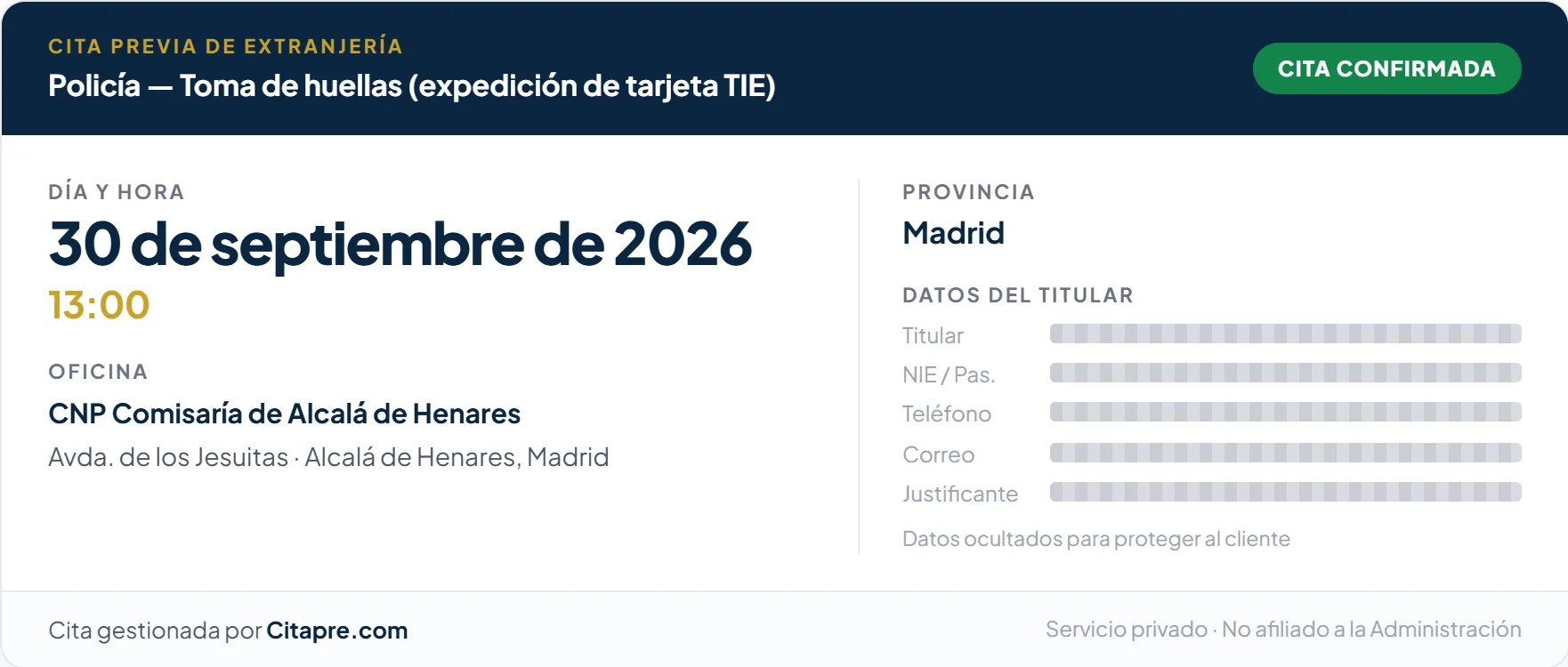
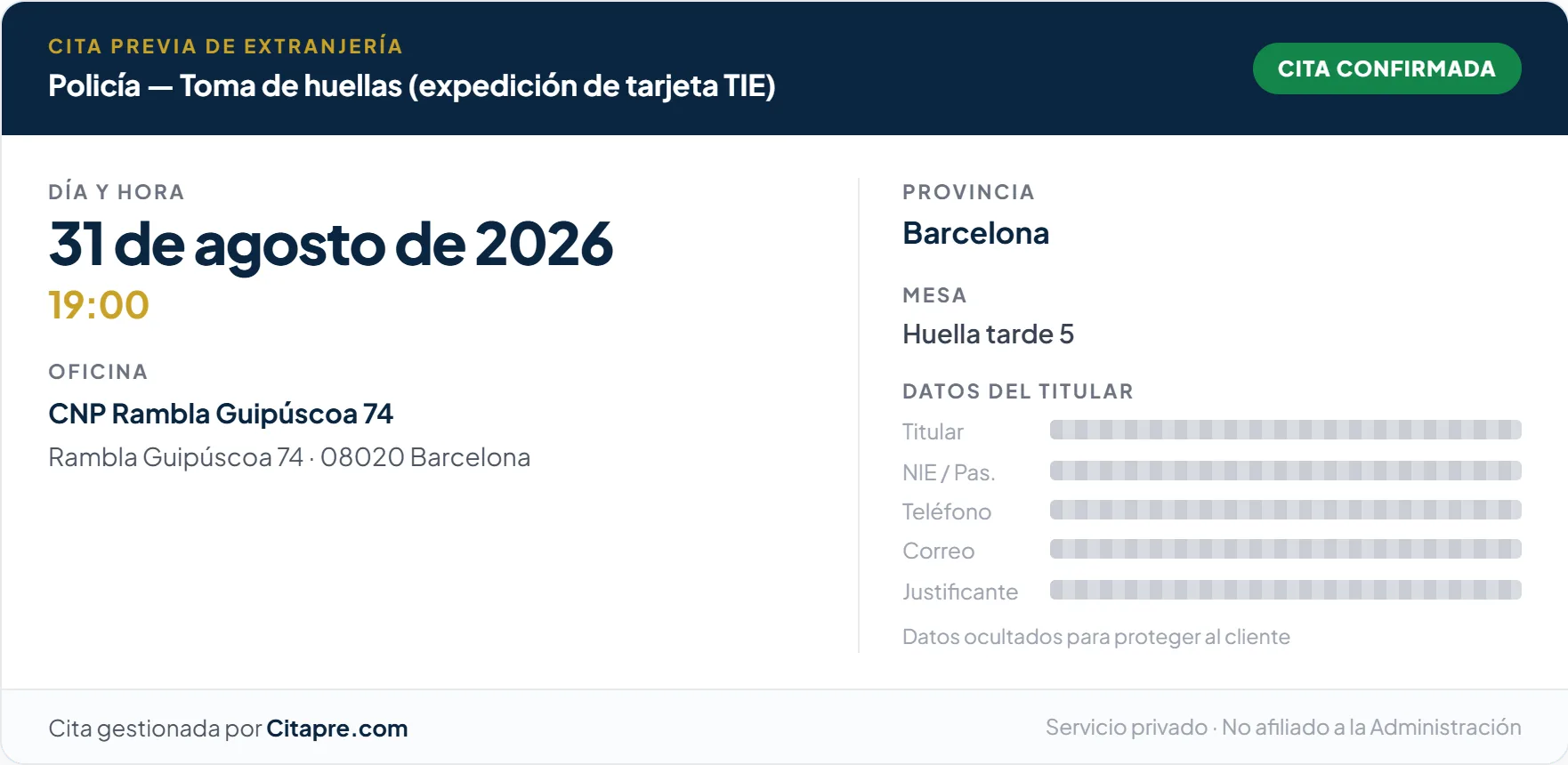
Real documents from appointments we booked, with the holder’s details covered. The procedure, date, time and office are the ones printed on the confirmation. Availability depends on the administration: we do not promise specific dates.
No payment upfront
You pay only once the appointment is confirmed.
Continuous monitoring
We watch the official system until a slot opens.
All 52 provinces
In seven languages, by WhatsApp or through the form.
“I had a very good experience with my appointment. The service was excellent, professional, and very helpful. Everything was handled smoothly and efficiently. I would definitely recommend their service.”